How to Melt Perler Beads Without an Iron
Updated September 2026 · ~7 min
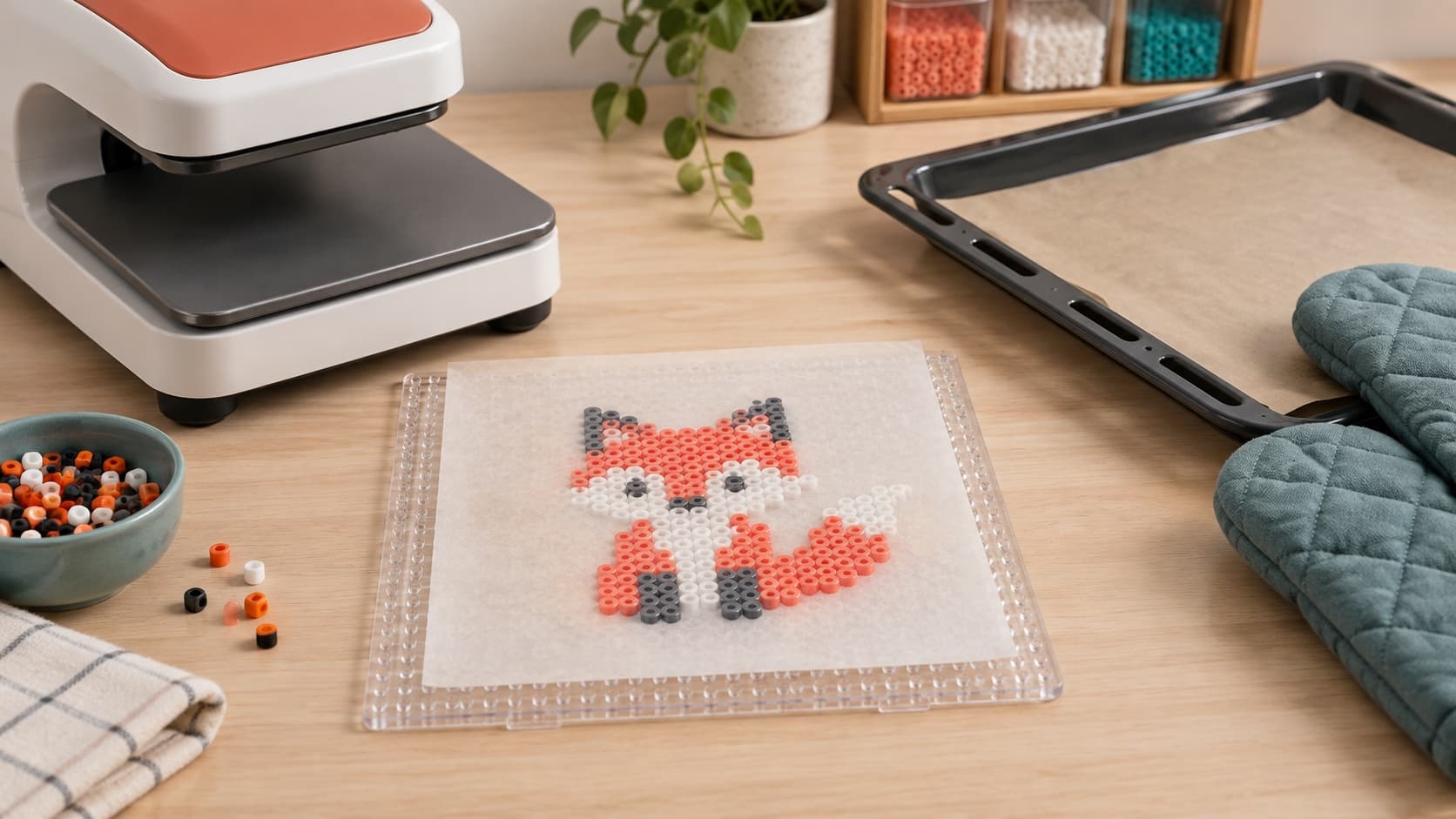
The short answer
If you need a pegboard pattern to stay intact, the manufacturer-backed method is still a dry household iron, ironing paper, and steady circular movement. Perler's official oven method is for flattening loose beads placed upright on a lined baking sheet—not for preserving a design on a plastic pegboard.
A small, flat, temperature-controlled craft heat press can imitate an iron, but it is not the standard method published by Perler or Hama. Use it only if its manufacturer allows this material and setup, test spare beads first, keep a paper barrier in place, and have an adult operate it. If you do not have a controlled flat heat source, wait until you can use the proper tool.
Do not put the pegboard in the oven
Perler's FAQ describes an oven craft in which loose beads stand upright on parchment on a baking sheet and flatten into separate disks. That can make components for jewelry or garlands. It does not fuse your existing grid into one sheet, and the plastic pegboard is not part of that method.
Follow the current Perler FAQ exactly if you choose that loose-bead project. It calls for adult supervision and provides its own temperature and timing. Do not improvise by baking a finished pegboard.
Options compared
| Method | Keeps a pattern? | Recommendation |
|---|---|---|
| Dry household iron | Yes | Official standard method |
| Flat craft heat press | Potentially | Test first; follow the press manual |
| Oven with loose upright beads | No | Different craft described by Perler |
| Microwave, flame, hair dryer | Unreliable | Do not use |
If you use a small craft heat press
- Check the heat-press manual and bead-brand instructions first.
- Work on a flat, heat-safe surface with an adult operating the press.
- Make a tiny sacrificial sample on the same type of board and beads.
- Cover every bead with reusable ironing paper or parchment suitable for the task.
- Use the lowest controlled setting that produces a bond; avoid heavy pressure.
- Apply brief, even passes. Stop and inspect rather than holding heat in one place.
- Let the piece cool under a flat weight before lifting it from the board.
These are cautious adaptation principles, not an official Perler or Hama procedure. Equipment varies, and a press can heat a larger area faster than an iron. A failed sample is cheaper than a warped board or a ruined full-size pattern.
Why a microwave, open flame, or hair dryer is a bad substitute
A microwave does not give the controlled flat contact the pattern needs. An open flame concentrates heat and adds a fire and burn risk. A hair dryer usually moves beads before it forms an even bond and can overheat nearby surfaces while still leaving weak joins. None gives the steady, paper-separated contact used in the official method.
The reliable iron method, when one is available
Perler's standard fusing instructions call for a household iron on a medium setting, ironing paper, circular motion, and roughly 10–20 seconds per side while checking progress. Hama likewise tells users to use ironing paper and keep the iron moving in smooth circles. Settings and melt speed vary, so the instructions packed with your beads take priority.
Adults should do the fusing. Use a heat-safe work surface, switch off steam, never leave the hot tool unattended, and let the piece cool before handling it.
Plan the pattern before adding heat
A smaller, well-edited chart is easier to fuse evenly than a sprawling field of loose details. Use the free pattern maker to crop your source, choose a board size, limit colors, and remove isolated cells before placing beads. For pattern selection, see our Perler bead patterns guide.
FAQ
Can you melt Perler beads in the oven?
Perler publishes an oven method for loose beads standing upright on a parchment-lined tray. It makes separate flattened beads; it is not a way to fuse a pegboard pattern, and the pegboard should not go in the oven.
Can I use a hair straightener?
It is difficult to keep a paper barrier, even temperature, and flat pressure across a design. Use the standard iron method or a purpose-built, temperature-controlled flat press that explicitly permits the setup.
Can I use parchment paper?
Use the ironing paper supplied with the beads or parchment suitable for the task. Never put the hot tool directly on the plastic beads.
What if I have no safe heat source?
Leave the beads on the pegboard in a level place and fuse them later. Moving the board carefully is safer than improvising with flame or uncontrolled heat.