Perler Bead Patterns: Ideas, Sizes, and Free Charts
Updated September 2026 · ~9 min
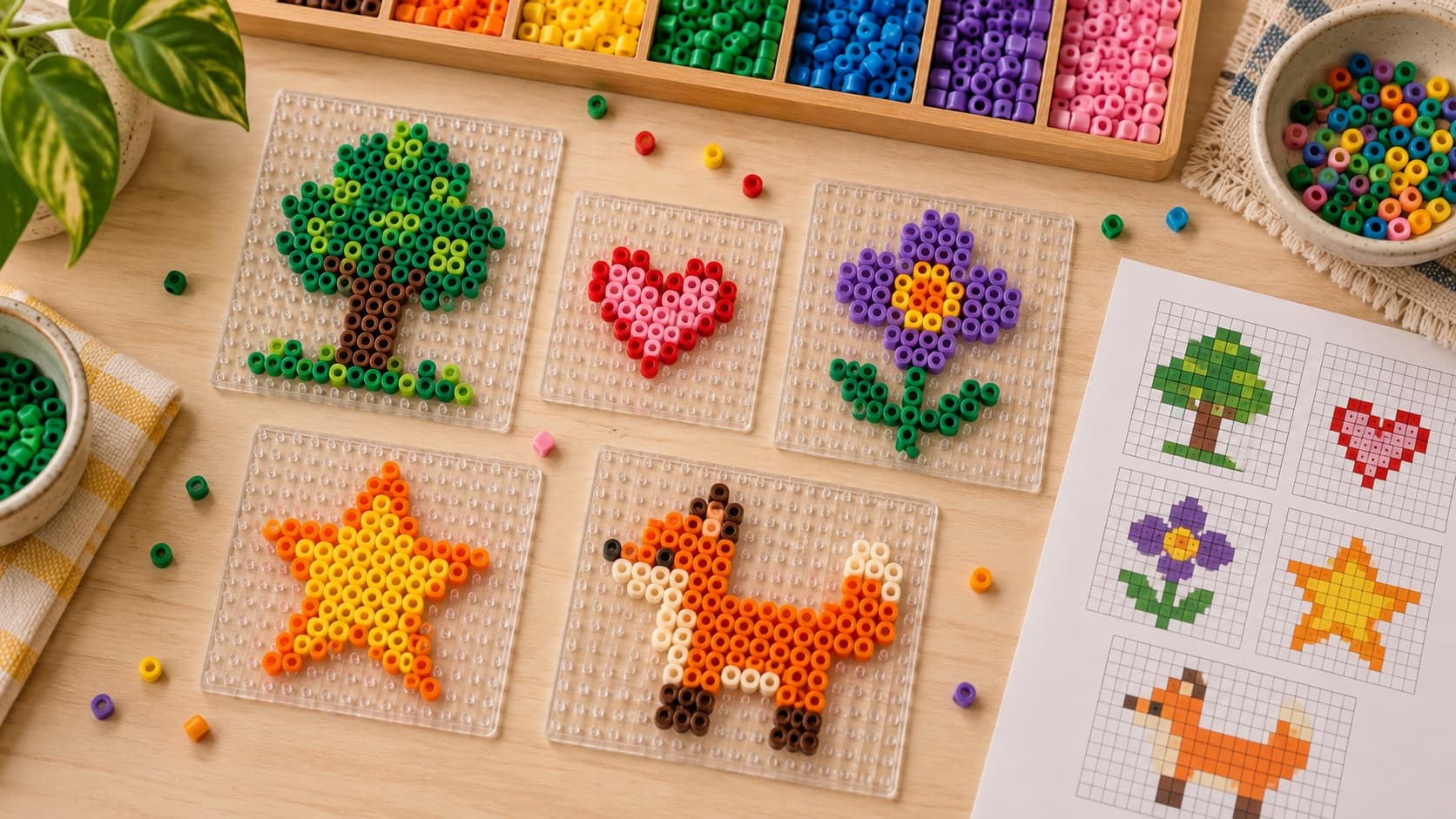
Quick answer
The best Perler bead patterns are not necessarily the biggest or most detailed. They fit a pegboard you own, use a color list you can source, and keep the subject readable at bead scale. Start with a 29-bead board for icons and coasters; move to joined boards only when the silhouette still needs more detail.
If you have an image you are allowed to use, the quickest free route is to convert it into a grid, choose your bead brand, limit the palette, and export a chart plus counts.
Perler bead pattern ideas by difficulty
| Level | Good subjects | Why they work |
|---|---|---|
| Beginner | Hearts, stars, fruit, simple flowers | Clear outline; 2–6 colors |
| Intermediate | Animals, trees, small landscapes | More shading without a huge board |
| Advanced | Pet portraits, architecture, detailed scenes | Benefits from a larger grid and color cap |
A strong outline matters more than photographic realism. When an icon still reads as a one-color silhouette, it usually survives the jump to a small pegboard. Thin whiskers, tiny text, and soft shadows often disappear unless you enlarge the grid.
Choose a pattern size before choosing the details
One chart cell equals one bead. A 29 × 29 square can hold 841 beads if every peg is filled; doubling both dimensions roughly quadruples the possible bead count. That is why a modest-looking size increase can turn a one-evening project into a multi-session build.
- Small board: icons, keychains, magnets, and first projects.
- Medium grid: animals, characters you designed, and simple portraits.
- Joined boards: detailed photos or wall art; test a cropped version first.
Board dimensions vary by product, so count the pegs on your board or check its packaging before printing a chart at full scale.
How to make a free Perler bead pattern from your own image
- Choose a high-contrast image you own or have permission to use.
- Crop tightly around the subject; empty scenery spends grid cells.
- Open the free browser editor and set the long edge to your board.
- Select the palette that matches the bead brand in your trays.
- Cap the number of colors, then check the eyes and outer contour.
- Export the PNG chart and material list before placing beads.
Try the free pattern editor or read the pattern maker guide for a feature-by-feature walkthrough. The conversion runs locally in the browser; screen colors are planning approximations, so compare important colors with real beads before buying in bulk.
Make the chart easier to build
- Remove isolated single pixels unless they carry an important feature.
- Keep adjacent dark colors distinct enough to see under room light.
- Use empty cells for the background instead of filling a large white rectangle.
- Print or zoom the chart so grid lines and color codes stay legible.
- Sort beads before you begin and keep a few extras of high-count colors.
For general materials and fusing steps, see how to make Perler bead patterns. Adults should handle the heat step and follow the instructions for the bead brand and equipment being used.
Original ideas beat a random image dump
Search galleries are useful for inspiration, but an image of finished bead art is not automatically a printable chart or permission to reproduce a commercial character. For gifts, sales, or classroom packs, use your own artwork, public-domain material, or assets whose license allows the intended use. A converter changes the format; it does not change ownership.
FAQ
Where can I get free Perler bead patterns?
Official brand project pages, creator-shared charts, and your own converted artwork are useful sources. Check the license before redistributing or selling a design.
What is a good Perler bead pattern for beginners?
Choose a small heart, fruit, flower, or geometric icon with a clear outline and no more than about six colors.
How large should a photo pattern be?
Start near 50–58 beads on the long edge for a cropped subject. Test smaller first; more cells mean more beads and much more placement time.
Can I use Hama or Artkal beads with a Perler chart?
The grid concept transfers, but colors and sometimes bead sizes differ. Map the chart to the brand you actually own and avoid mixing sizes without a physical test.